Skip to content
Many assume “waterproof” means safe anywhere. But misunderstanding IP ratings like IP44, IP65, or IP67 often leads to wrong product choices and early failures.
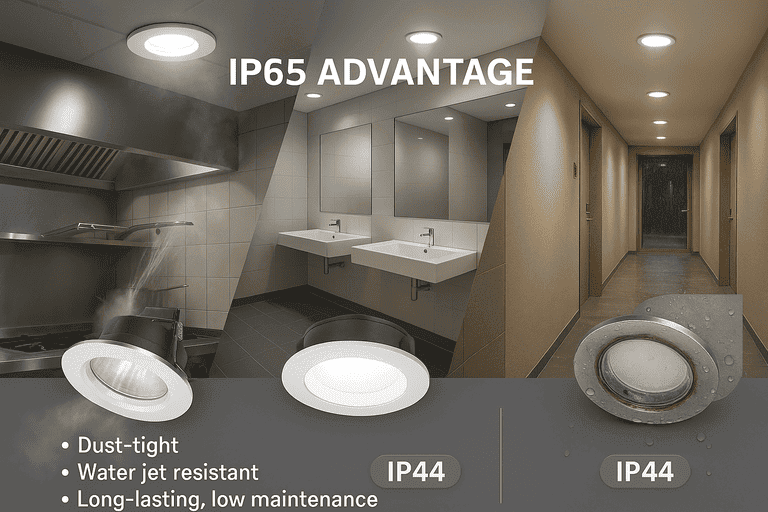
IP65 downlights are dust-tight and resist low-pressure water jets. That makes them suitable for wet indoor areas and light outdoor exposure. But not for high-pressure cleaning or submersion.
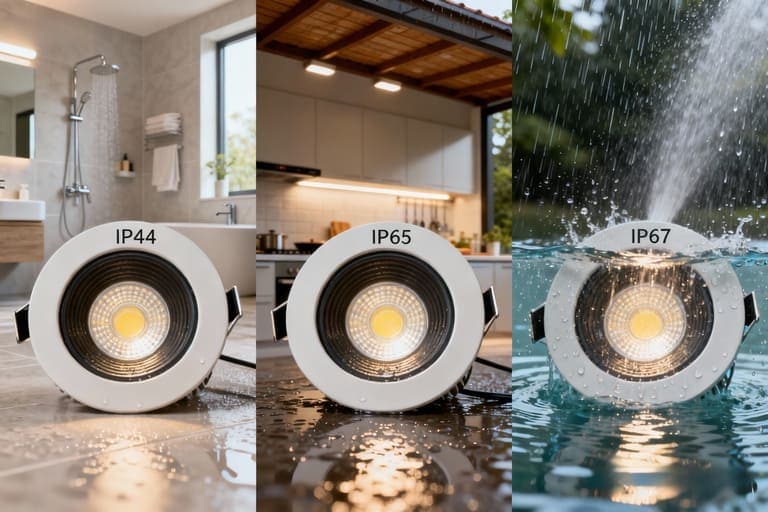
How does IP65 compare with IP44, IP55, and IP67 ratings?
IP ratings define how well a fixture resists dust and water. The first digit (0–6) means solid particle protection1. The second digit (0–9) covers water resistance2. Here’s how common ratings stack up.
| Rating | Dust Protection | Water Protection | Typical Use Cases | Key Difference from IP653 |
|---|---|---|---|---|
| IP44 | ≥ 1 mm object entry | Splash-proof (from any direction) | Indoor damp areas (not direct spray) | Can’t handle jets or washdowns |
| IP54 | Limited dust ingress | Splash-resistant | Sheltered outdoor zones | Weaker than IP653, not for direct water exposure |
| IP653 | Dust-tight | Low-pressure water jets | Kitchens, washrooms, outdoor soffits | Balanced protection for indoor/outdoor wet zones |
| IP66 | Dust-tight | Strong jets and high-pressure sprays | Exterior walls, car parks, kitchens | Tougher against pressure and cleaning chemicals |
| IP67 | Dust-tight | Short-term water immersion (1m, 30 min) | Poolsides, landscape, buried fixtures | Handles flooding, not just spraying |
| IP68+ | Dust-tight | Long-term immersion, high-pressure jets | Pools, fountains, industrial washdowns | Far stronger than IP653, for harsh conditions |
From this, IP653 sits in the middle. It’s strong, but not enough for extreme water or full submersion.
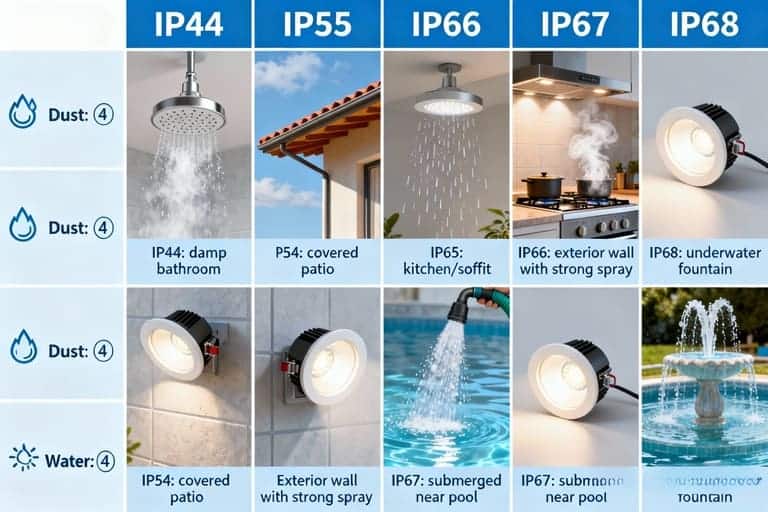
Which IP rating is recommended for bathrooms vs outdoor areas?
You can’t use one rule for all. It depends on where and how water reaches the light. Here’s how I break it down for clients:
Use IP44 in dry or lightly damp indoor areas. For example, ceiling lights far from showers.
Use IP65 in bathroom ceilings near showers, kitchen ceilings, or semi-open corridors. It’s also good for soffit lights and entryways exposed to rain.
Use IP66 in food prep zones with daily washdowns or for outdoor spots facing strong storms.
Use IP67 or above for fixtures near ground level that could be flooded, or anywhere with standing water risk.
| Area | Minimum IP Rating | Reason |
|---|---|---|
| Bathroom ceiling (near shower) | IP65 | Humid air and water spray |
| Hotel vanity area | IP44 | Low splash risk |
| Restaurant kitchen | IP66 | Jet cleaning and steam exposure |
| Car park soffits | IP65 | Outdoor exposure, water jets |
| Poolside or near drains | IP67 | Temporary immersion during cleaning or storms |
| Garden buried lights | IP68 | Constant water contact |
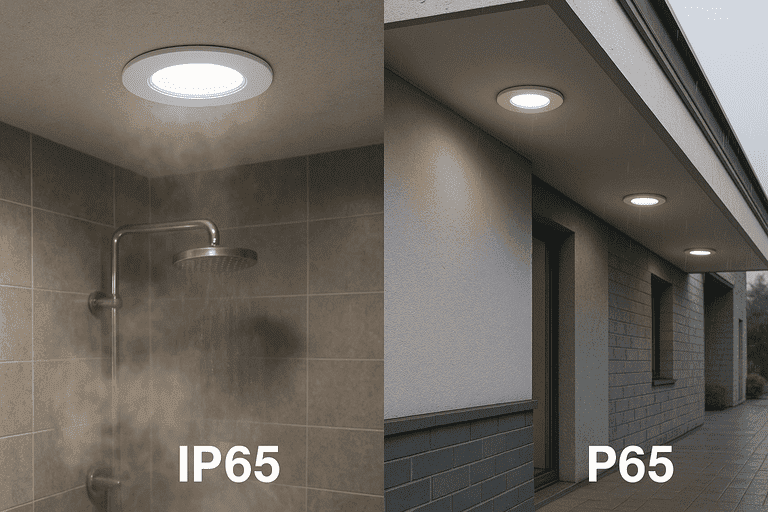
What are the benefits of choosing IP65 over lower ratings?
IP65 fixtures give you solid protection—without overpaying for unnecessary waterproofing. They balance performance and cost for most commercial use cases.
You get full dust protection4, so no internal buildup that affects performance. You get water jet protection5, which means you can install them in kitchens, wet ceilings, or semi-exterior ceilings with peace of mind. Lower ratings like IP44 may save money upfront, but fail in just one rainy season or after a few washdowns.
If you’re lighting a hotel washroom cluster, restaurant overhang, or office bathroom ceiling, IP65 is the safe default. You don’t need IP67 unless there’s a flooding risk. IP65 gives you a durable base level of moisture and dust protection for most dry and wet zones.
Are there situations where IP65 is not sufficient?
Yes. And I’ve seen projects go wrong by trusting the label too much. You must look beyond the IP number to how it’s actually built.
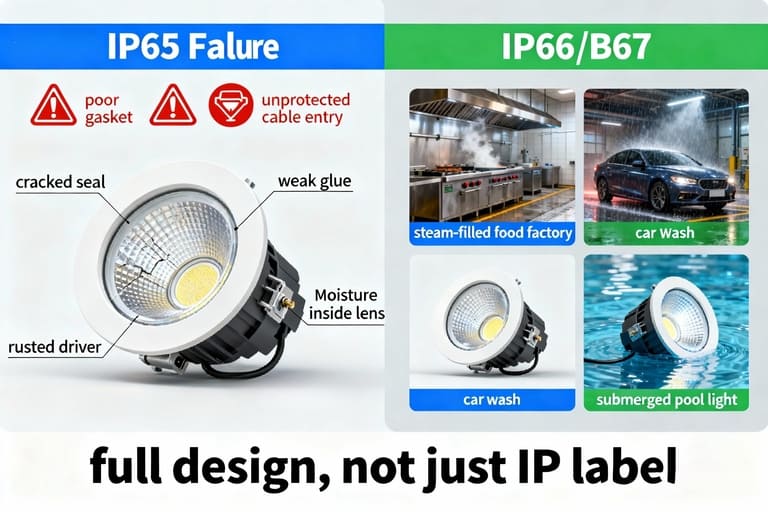
An IP65 rating doesn’t guarantee water stays out forever. If the gasket is cheap, the housing isn’t sealed well, or the driver isn’t protected, water still gets in. I’ve seen “IP65” lights fail in six months because of bad sealing, poor vent design, or cracked glue joints.
IP65 also can’t survive full cleaning with steam or strong pressure. And it can’t handle water immersion6. So in car washes, food factories, swimming pool areas, or low-mounted outdoor lights—IP65 is not enough. You need IP66 for pressure jets and IP67+ for immersion.
Always check the full design: how the light seals the LED, the driver, and the cable entry. Does it have vent channels or drain holes? Are the seals UV- and heat-resistant? Only then is IP65 “real.”
Conclusion
IP65 gives solid water and dust protection for most indoor wet areas and light outdoor use. But you must verify build quality—and upgrade to IP66+ if facing pressure or immersion risks.
-
Understanding solid particle protection is crucial for selecting the right IP rating for your needs, ensuring safety and durability. ↩
-
Exploring water resistance in lighting can guide you in selecting fixtures that withstand various environmental conditions. ↩
-
Understanding the IP65 rating helps you choose the right fixtures for wet areas, ensuring durability and safety. ↩ ↩ ↩ ↩ ↩
-
Understanding full dust protection helps ensure optimal performance and longevity of your lighting installations. ↩
-
Learn about water jet protection and its importance for ensuring durability in wet environments. ↩
-
Exploring this topic will clarify the importance of selecting the right IP rating for applications involving water immersion, enhancing safety and reliability. ↩